


The minute we bring AI into the electronic medical record, we can finally capitalize on the benefit of having a digital record. Now we get the best of both worlds.
— Dr. Kyle Fortinsky
Dr. Kyle Fortinsky is a gastroenterologist in Barrie, Ontario, and a co-founder of CleverConsult, which reads referral packages and charts and drafts the consult note before the patient walks in. We talked about where the idea came from, the 400-page referral, why every fact in a CleverConsult note links back to its source, matching patients to clinical trials, and why he thinks the best specialty tools will be built by specialists.
Edited for length and clarity. My questions and comments are in bold.
Where it started
Dr. Phua: Dr. Fortinsky, you're a practising gastroenterologist in Barrie. What did a clinic day look like before you built CleverConsult, and when did you decide to build something rather than keep carrying the cognitive load of pre-charting and charting?
Dr. Fortinsky: It dates back to residency. I'd see five or six patients in a half day, and seeing them was the easy part, and the enjoyable part. The hard part was reviewing very long charts and pulling it all together. Writing the note afterward often took even longer.
The idea really came from one doctor: Dr. Gary Lewis, a well-known endocrinologist. His secretary pre-populated his notes. When you showed up to his clinic as a resident, the labs, imaging and past medical history were already there. You just filled in the HPI and the impression and plan. I remember him saying, "Isn't it so luxurious to work like this?"
Even as a resident, it made no sense to me that he was the only doctor doing this. My biggest pet peeve is clinics that consistently run late. We all run behind sometimes, but if you're consistently two hours behind, something isn't working. A close second is doctors staying up late into the evening to finish their notes.
When I started my own practice, I was spending hours pre-populating notes myself, doing exactly what I'd said made no sense. So I started by hiring humans. I don't know if you know what humans are.
Dr. Phua: The pre-AI solution.
Dr. Fortinsky: Exactly. Initially a pre-med student, then a pharmacy student who became my sister-in-law. I trained them on my template: read the referral, the labs and the imaging, and populate the note.
It saved me at least an hour or two a day. At $25 an hour, it took them two or three hours to prep an entire clinic. I wasn't trying to see more patients, though I easily could have seen three or four more. The whole day was just nicer.
I teamed up with a longtime friend and colleague whose wife is an endocrinologist. My first idea was to hire students at scale. Then AI came along, and I realized it could solve this for a lot of people.
Today my notes are created instantly. About 80% of each note is done before I set foot in the room, and I feel like a better doctor for it. The point isn't to see 80 or 100 patients a day. It's to spend more time with each one, because I'm not worried about the documentation.
Pre-AI, this would never have been possible. Specialists have long wait times. This is a small way to make the system more efficient, improve patient care and improve physicians' lives. That was the goal.
The referral problem
Dr. Phua: I think of the referral problem and pre-charting as very similar problems. My understanding is that GI referral packages can run 20 pages, sometimes 50, with handwritten notes thrown in, and all of it has to be sorted, organized, categorized and verified. At a high level, what does a typical GI referral workflow look like before the patient walks in? It's the first thing CleverConsult solves.
Dr. Fortinsky: Referrals range widely. You're a family doctor, so you know: a referral can be one line, or even one word. "Dysphagia." "Abdominal pain." Nothing else. For those, we send patients a questionnaire in advance and their answers flow into the note. So the problem isn't always too much information. Sometimes it's too little.
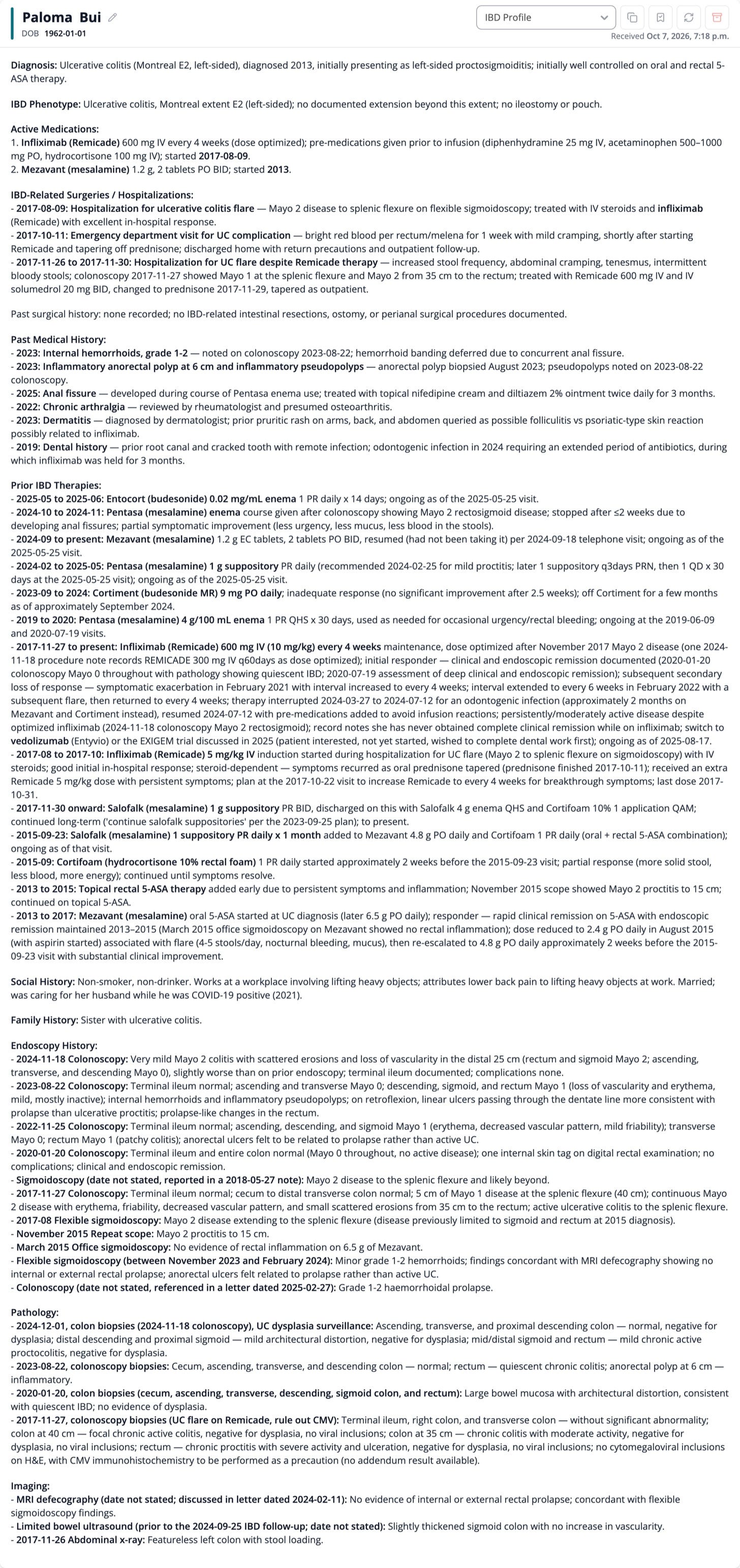
On the other end, the longest referral I've seen was around 400 pages. Some doctors, maybe on a transfer of care, send everything so whatever you need is in there somewhere. It's like discovery in those legal shows: send the other side a truckload of paper and bury the one page that matters.
The reality is we often don't have time to read every page. If I'm reviewing 30 or 40 referrals a day, I'm not reading a 60-page referral closely up front. I skim to make sure nothing important jumps out, then go back if something comes up when I meet the patient.
Our goal is a structured, repeatable way to review the referral and extract what really matters. AI makes mistakes. So do doctors. To be clear, for CPSO and CMPA purposes, the doctor still has to review the whole referral package. They can't rely on an AI summary, and our terms of service say so.
But let's be transparent: the status quo carries a massive risk too, which is that doctors aren't reading it at all. AI's errors of hallucination have to be weighed against the errors of omission and document fatigue happening now. Think of it like a rear-view camera. You should still look around and pay attention, but it makes the drive safer.
Dr. Phua: I love that framing, because I think it's precisely correct. These comparisons often get made in a vacuum. Take self-driving cars: you don't compare an assistive technology to a perfect human driver. That isn't a fair standard. You compare it to the median human driver, and if it's 99% safer than the median driver, a very low error rate isn't a reason not to use it. On net, it saves lives.
Why every fact links to its source
Dr. Phua: I want to double-click on verification. Every fact in a CleverConsult note links back to the page it came from, almost like hyperlinking on the old web. I'm sure that was deliberate. Why was it non-negotiable?
Dr. Fortinsky: It goes back to the human in the loop. We're comfortable with the mistakes being made right now. We understand a tired or distracted driver, but not an assisted-driving car that ignores a sign. Medicine is the same. We accept a resident or physician who doesn't read the whole package and misses something important, but we're not comfortable with the new kinds of mistakes AI makes. We have to learn to recognize them and mitigate them.
Terms of service weren't enough for me. At the bottom of Claude, it says, "Claude is AI and can make mistakes." If the best AI in the world spends valuable screen space telling you that, you can be sure every AI platform makes mistakes.
Source links guard against complacency. Even when the summary is clean, and even once you trust it, if a result matters to your patient's care, whether it's an MRI or a pathology report, you shouldn't be reading the AI's version. You should be checking the source. So we make that as easy as possible.
It's also what our users demanded, including me. And it makes an 800-page chart searchable. To verify something, you don't dig through 800 pages. You pull up the page you need.
Trial screening
Dr. Phua: I want to touch on trial screening. My understanding is that screening patients effectively takes an overwhelming amount of administrative work, and if you can automate a big chunk of it, you help patients get into trials, which obviously benefits them. How do you think about that problem and your solution?
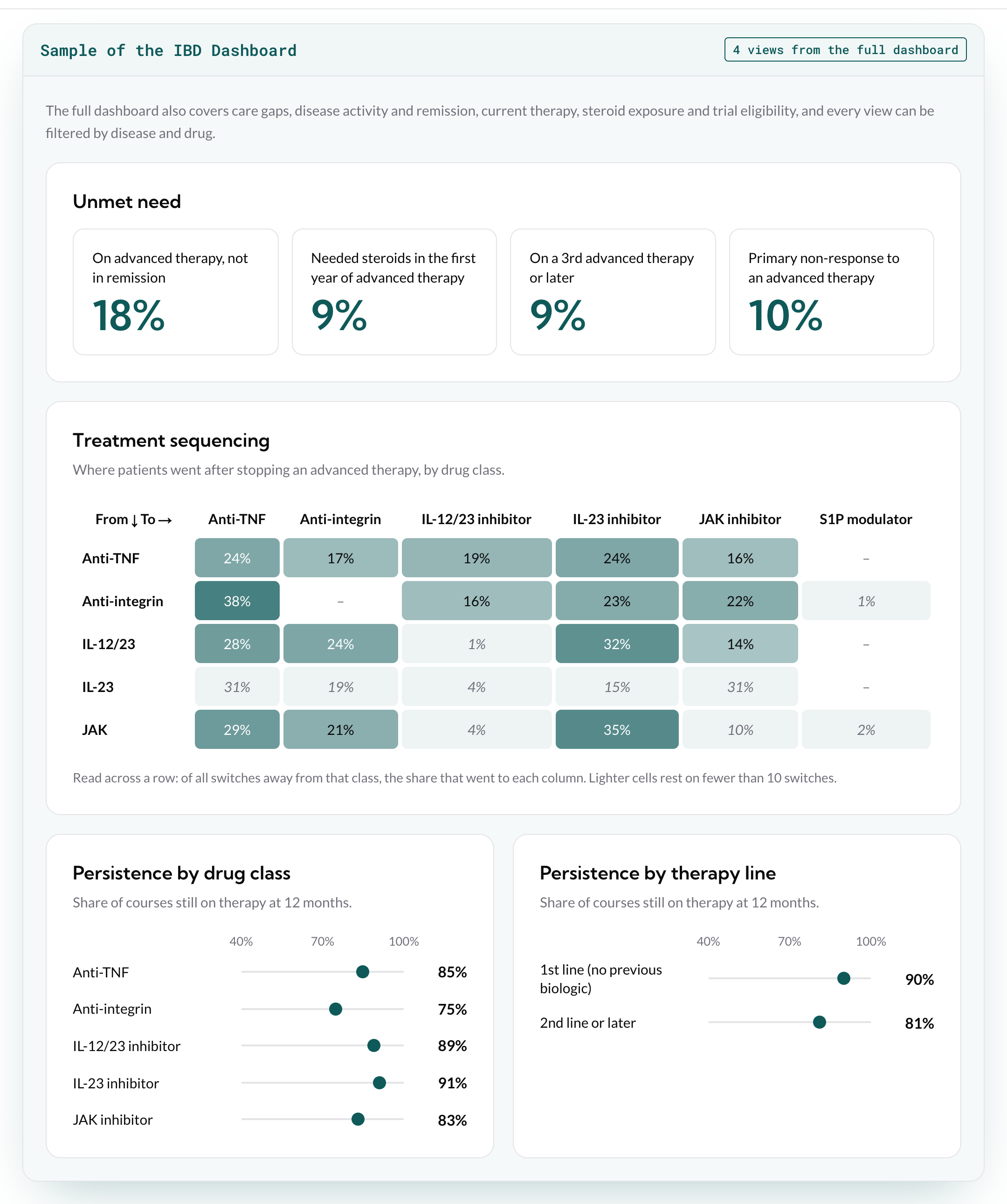
Dr. Fortinsky: This is where it gets specialty-specific. In the weight-loss drug space, eligibility can be simple: BMI and a few comorbidities. In inflammatory bowel disease, it can turn on a dozen or more factors: where the disease is, how severe it is, which treatments the patient has already tried. For the average physician in a busy clinic, working out which patient fits which trial is close to impossible.
The way we hear about trials doesn't help. You get emails for months, hear about it at a dinner, then from a colleague, and you finally understand the criteria: failed these two drugs, never exposed to this one, this type of disease and not that one. By then the trial is closed and they're telling you about the next one.
You could ask an AI to search clinicaltrials.gov, but that misses two things. First, you need the patient's entire disease history, which means access to the full chart. Second, it isn't about which trials exist. You don't care about a trial at Johns Hopkins in Baltimore. You care about one at a site near you.
So we map the patient's whole disease journey against the trials in that provider's area. When there's a potential match, the physician can say in real time: before we start another treatment, you should know there's a trial.
Here's the part I care about most. There are probably about 15 IBD trial sites across Canada, maybe a few more. If you're referred to one of them, you get every option. If you're not, your chance of being offered a trial drops significantly.
Democratizing this means that whichever GI you see, you can be offered a trial, the same way every drug treatment is offered across Canada. Most patients will say no, and that's their choice. But if a trial is a viable option and we never mention it, patients are disadvantaged by which office they happened to land in.
Asking every GI in Canada to do this manually comes at a huge time cost. We've made that process simple.
Built by specialists, on top of the EMR
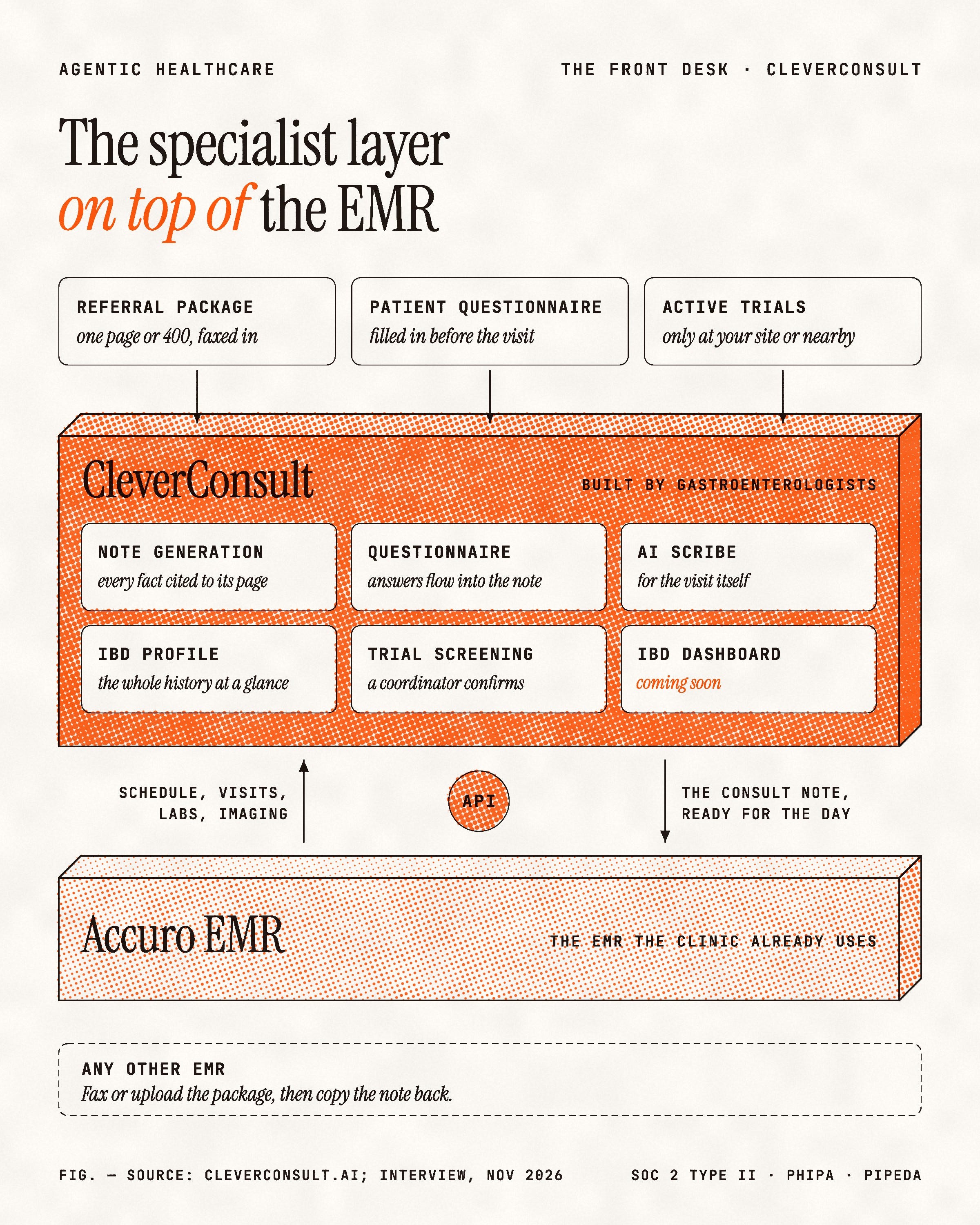
Dr. Phua: As I understand it, CleverConsult is a workflow optimization product with EMR-like features. It isn't meant to be a complete EMR. It sits on top of one, like Accuro, and integrates with it. We're seeing a pattern where specialists build streamlined tools that sit on top of an EMR and do a couple of things extremely well, without needing to do a bunch of ancillary things. How do you think about the category you're building? Do you have a name for it, or a mental model?
Dr. Fortinsky: I think about this a lot.
I've sat through pitches at health tech AI conferences, and so many felt out of touch with what's happening on the ground. People love to generalize that doctors are terrible businesspeople. I'll make one of my own: non-clinicians are terrible at fixing doctors' workflows.
Doctors don't have it all figured out, and sometimes you need an outside view. But you can't rebuild a workflow you don't understand. And most products are built for primary care, because it's more than half the market. Very few solve problems for specialists.
So I don't care what you call the category: workflow, administrative automation, billing, clinical decision support. If you're solving a problem clinicians consistently tell you they have, it's all under the same umbrella.
Could one EMR with every tool built in solve all of this? In an ideal world, yes. Here's why it doesn't work. I heard one of Anthropic's co-founders say Claude Code is so powerful because it works with whatever your team already uses. It doesn't ask you to change your workflow.
I learned this early trying to sell my product: the hardest thing is changing how people work. People say the EMR is terrible, so build a new one. You've probably never talked to a doctor. Most doctors never change their EMR in their entire career. Embedding in the workflow they already have is the most powerful way to create change.
I get asked about 10 times a week to build something unrelated that solves another pain point. Other companies, like Inference Health, are tackling other parts of the workflow. I'm staying focused on problems I understand very, very well.
I think the end result, as much as people fight it, will be a patchwork: a hundred different tools brought together, because every practice is different. A psychiatrist, an emergency physician like my wife, a dermatologist and an ophthalmologist all have different needs. The best urology solution will be built by a urologist, and the best GI solution by a GI. And with AI, building is far easier than it used to be.
The value will come from individual physicians with real pain points. Over time, mergers and acquisitions will probably package those solutions together. But the original ideas will come from bench to bedside. Gone are the days when companies with no experience of what we do could drop in solutions from the top down. It's going to be built from the bottom up.
Integrating with Accuro
Dr. Phua: Are you integrated with Accuro?
Dr. Fortinsky: Fully integrated. It was one of the most important things we could add. If you promise to save physicians time, then ask them to upload or fax in their data, it's a much harder sell. Now when you walk into your office, the notes for your whole day are already generated from your schedule. Everything pulls in and everything pushes back.
Physicians always ask: what's the catch? Is it expensive? Will it take more time? Even "now your admin can do this" gets pushback. My admin is already stressed, and pushing my task onto them isn't a benefit to me.
The goal is a better day-to-day without sacrificing quality or time with patients. Most of us don't want a tool that does our job for us. We just want to do our job better. And I have no idea how far this will go. Only time will tell how much better medicine can be.
The status quo isn't good enough
Dr. Fortinsky: People are scared of AI: for their jobs, for how medicine will change, for all the potential risks. But especially in Canada, the status quo isn't working. Wait times, missed test results, physicians burning out, populations that are growing, aging and more complex. It's stretched to the max. The status quo isn't good enough.
We'd never go back to paper charting. But medicine has been almost fully digitized for years, and we've never turned that into real patient benefit. We got better records and better communication, but we never leveraged the data.
Old-school doctors say all the time, "I miss paper charting; it was so much faster." And without AI, they're right: electronic records are slower and more tedious. The minute we bring AI into the electronic medical record, we can finally capitalize on the benefit of having a digital record. Now we get the best of both worlds.
Dr. Phua: That's the note I'd love to end on. Kyle, thank you so much for your time.