


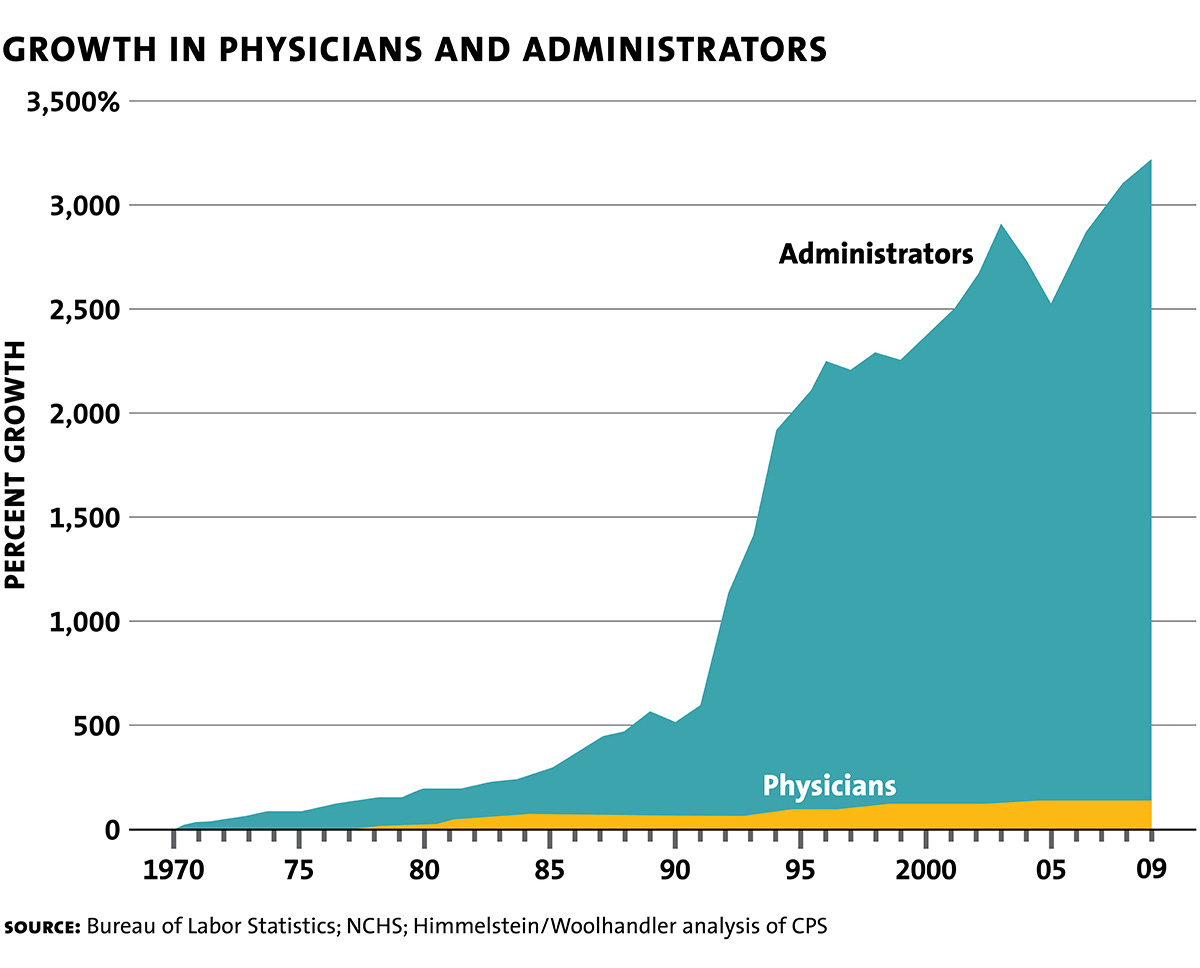
If you would please consult the graph…
There’s a famous graph that periodically goes viral every couple of months in healthcare.
I call it the “Kafka graph”—because everyone who’s ever worked in a healthcare setting knows how quickly and rapidly bureaucratic systems have hypertrophied in response to coordinating increasingly complex types of care in Canadian and US settings, creating enormous frustration for everyone involved.
If only we could radically simplify these systems!
The problem, of course, is that we need them.
As physicians or non-physician healthcare staff, almost everyone has a litany of stories when it comes to frustrations with some form of healthcare bureaucracy.
Consider the Canadian context, where patient and provider frustration-lists are inordinately long.
Patients frequently complain about any of the following:
Referrals getting dropped or missed by their family physician offices.
Difficulty located physicians who are taking patients even when they are available.
Lengthy and complex applications for critical services or paperwork for insurance-covered forms.
Slow, cumbersome, waits for life-saving treatments that require special approval from the Ministry of Health in Ontario.
Being bounced around different departments over the phone when trying to find the right contact for a community support service like home-care.
Providers and healthcare administrators encounter analogous problems around care coordination, getting support for clinical tasks, and losing track of patient journeys even within the context of their own clinic organizations.
The proliferation of bureaucracy in healthcare is an organic response to the increased complexity required to deliver modern care.
A bureaucracy is a computer; a healthcare bureaucracy is a very large computer

The simplest way to think about a bureaucracy is as a computer designed around natural language inputs & outputs.
Patients approach the front desk at a medical clinic and provide a specific set of inputs through verbal or written interactions (demographic information, PHI, their contact info).
In turn, they expect a specific set of outputs from their care providers (a clinical appointment, medical documents, forms).
The core functions of a healthcare healthcare bureaucracy is to process these inputs into outputs.
That is to say, a core function of this system is literally a form of computation.
Cognitive load is rapidly increasing for everyone involved
At baseline, a modern healthcare bureaucracy is a computer composed of human beings and rote-automated systems that are not capable of autonomous, intelligent action.
A bureaucracy is a kind of distributed intelligence that provides a laggard response because of the inherent problems with scaling multi-agent organizations wherein humans are the agents.
The problem with scaling human bureaucracies is that headcount scales linearly but coordination grows superlinearly:
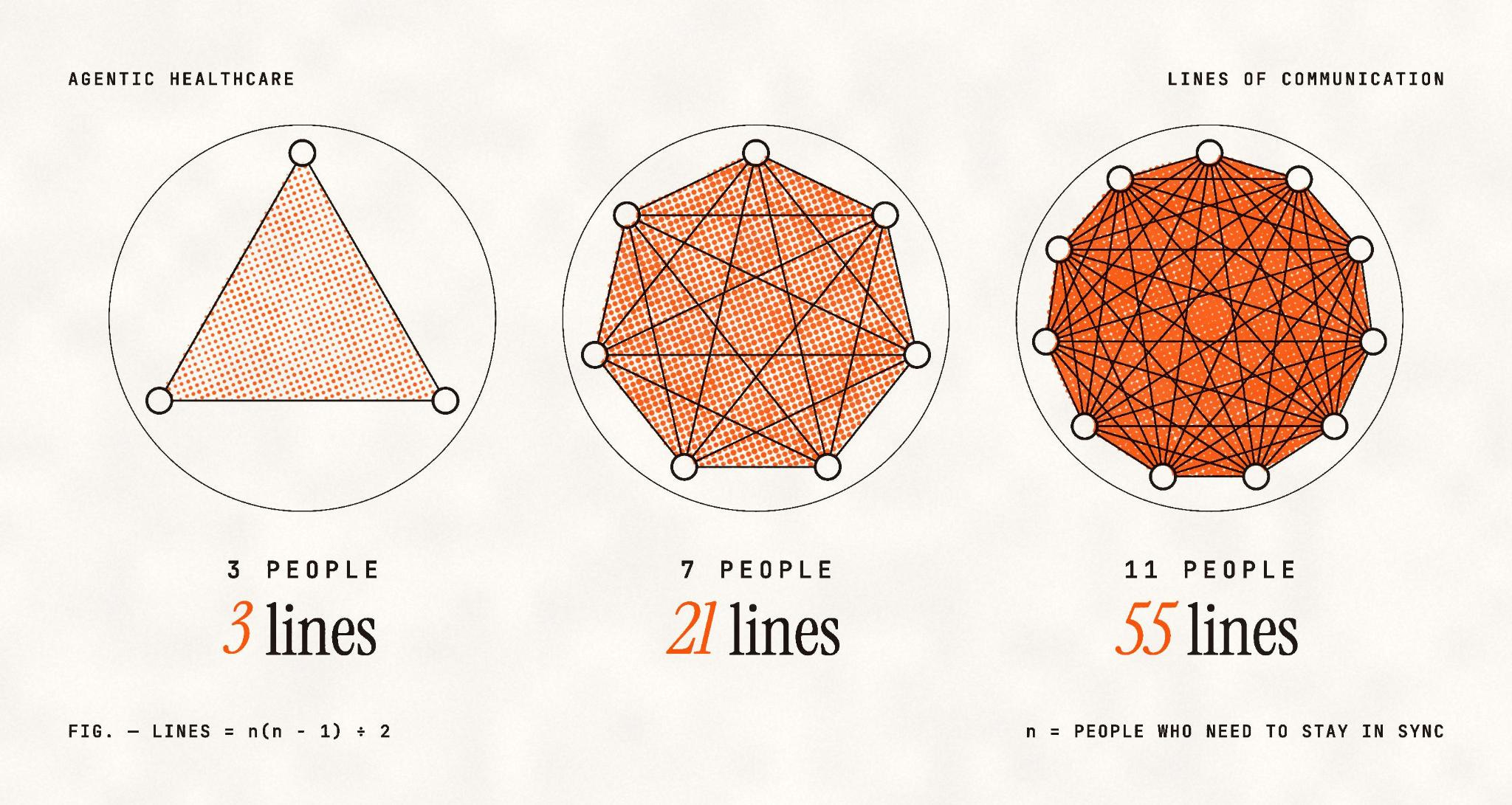
Broadly speaking, this essential constraint drives three core problems with the modern healthcare bureaucracies:
Latency:
Patient A wants to have an appointment scheduled as soon as possible. This takes days or even weeks.
Patient B wants a form they submitted to get approval for medication coverage. This takes days or weeks.
Error rate
Patient C requested a referral to a specialist several months ago. They call their family physician’s office and are informed that the referral was declined but none of their admin staff noticed due to a human error. Patient has to wait several more months for care.
Cognitive load for patients, providers and admins (mental exhaustion)
Patient D spends 2 hours on hold over the phone trying to arrange home care for their elderly parent because staff are overwhelmed with demand.
Primary care MD Dr. Z spends half an hour during their lunch break calling the office of specialist MD Dr. J to sort out the status of a referral that needs to be urgently seen.
AI agents can solve for all three core problems
Intelligent autonomy is now being driven down to the cost of tokens.
Consider how healthcare agents can solve for all three problems with counter-examples:
Latency:
Error rate
Patient C requested a referral to a specialist several months ago. The specialist forgot to follow-up. A fleet of AI agents autonomously monitoring for non-responding clinics checks in with the specialist clinic via a follow-up fax which their admin flags and responds to with an appointment confirmation. A patient delay is averted thanks to Inference Health.
Cognitive load for patients, providers and admins (mental exhaustion)
Patient D calls a busy home care service trying to schedule care for their elderly parents, but no delay happens because an AI voice agent responds immediately via Alaya Care.
Primary care MD Dr. Z faxes the office of specialist MD Dr. J to sort out the status of a referral that needs to be urgently seen. An AI agent automatically surfaces this priority flag to Dr. J’s operations team and the physician is notified of the priority booking via a dashboard being actively monitored by their staff using Inference Health. The patient is scheduled for an urgent consult the next day via a voice-agent that autonomously calls them.
AI agents in non-adversarial systems
In a cooperation-based bureaucratic system, AI agents facilitate a win-win cooperation dynamic where patients seeking care get access faster from service providers who want to provide it.1
This drives down latency, error rate, and cognitive load for everyone involved.
The dawn of the agent era in healthcare means that agent-powered institutions can emphatically “solve” for the core challenges inherent to scaling bureaucratic systems for healthcare administration.
Kafka didn’t anticipate tireless, intelligent, helpful automatons as a solution to bureaucracy—but thankfully, they’re here!
(Adversarial domains like legal and cyber are a different story, of course).