


One of the most frustrating things I see as a commentator in Canadian healthcare is the difficulty in reasoning from first principles.
It feels, very often, that we are having the same conversations at the systems level on a loop that repeats every year.
Consider the case of the primary care shortage in Canada: in theory, you could solve a huge chunk of the outpatient care shortage if clinicians could see more patients while maintaining safety and quality of care.
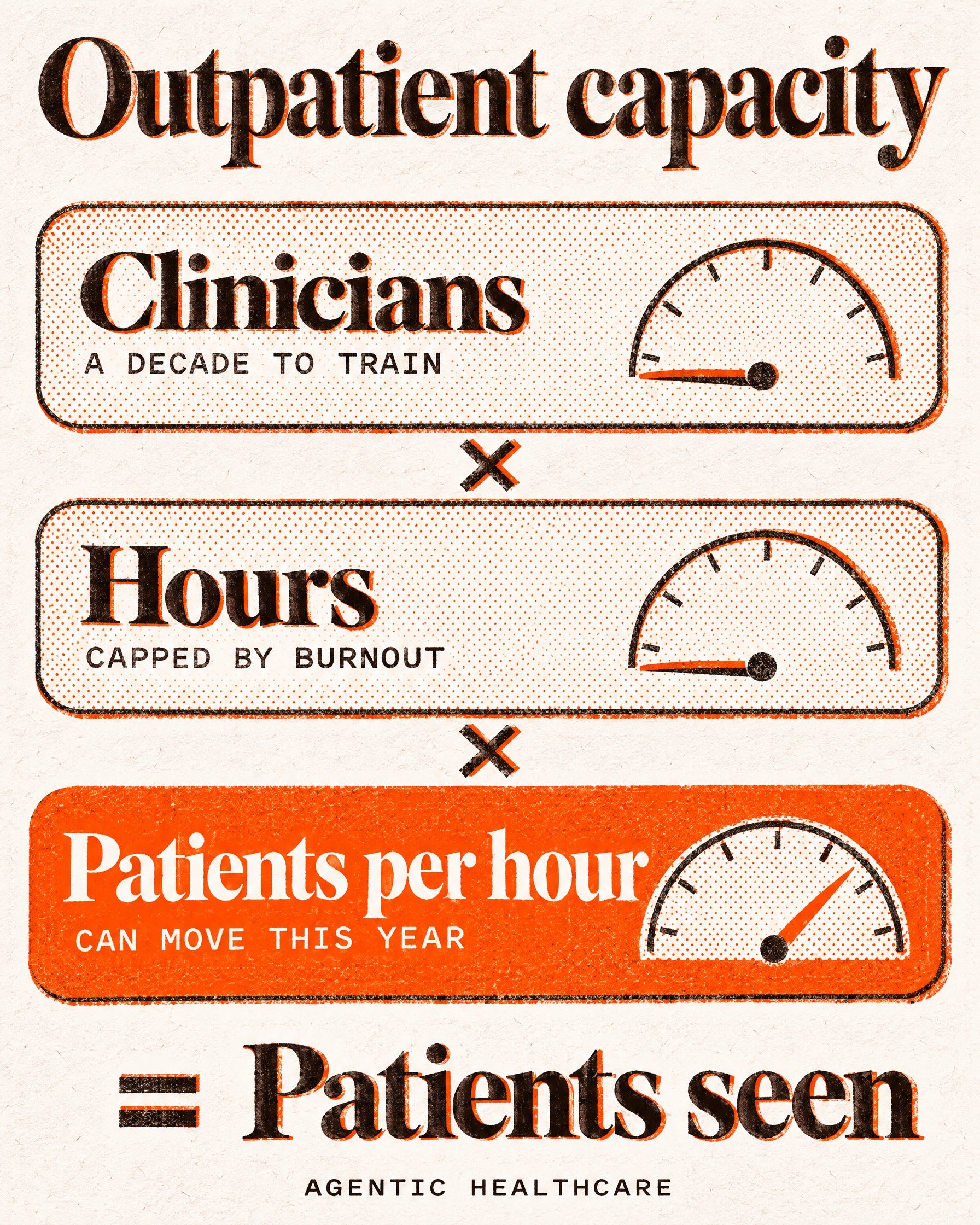
Outpatient capacity is a simple equation: number of clinicians × hours worked × patients seen per hour.
Before foundation models radically improved in capabilities, clinical intelligence was a scarce resource.
Now, it is being driven down to the cost of tokens.
When cognitive resources were constrained and finite, healthcare systems were forced to make tradeoffs between speed of care and quality of care - take a good doctor and force them to go too fast, and you will get more errors.
Now, we can treat fixed constraints as obstacles to route around rather than overcome directly. We can’t change the number of family physicians quickly - training a family doctor takes the better part of a decade. We can’t push the number of hours worked much further either - clinicians are already burning out.
That leaves one lever that can meaningfully move in the outpatient setting: patients seen per hour.
When I work with clinicians, I think of them as highly skilled specialists who are intent on deleting as much friction as possible.
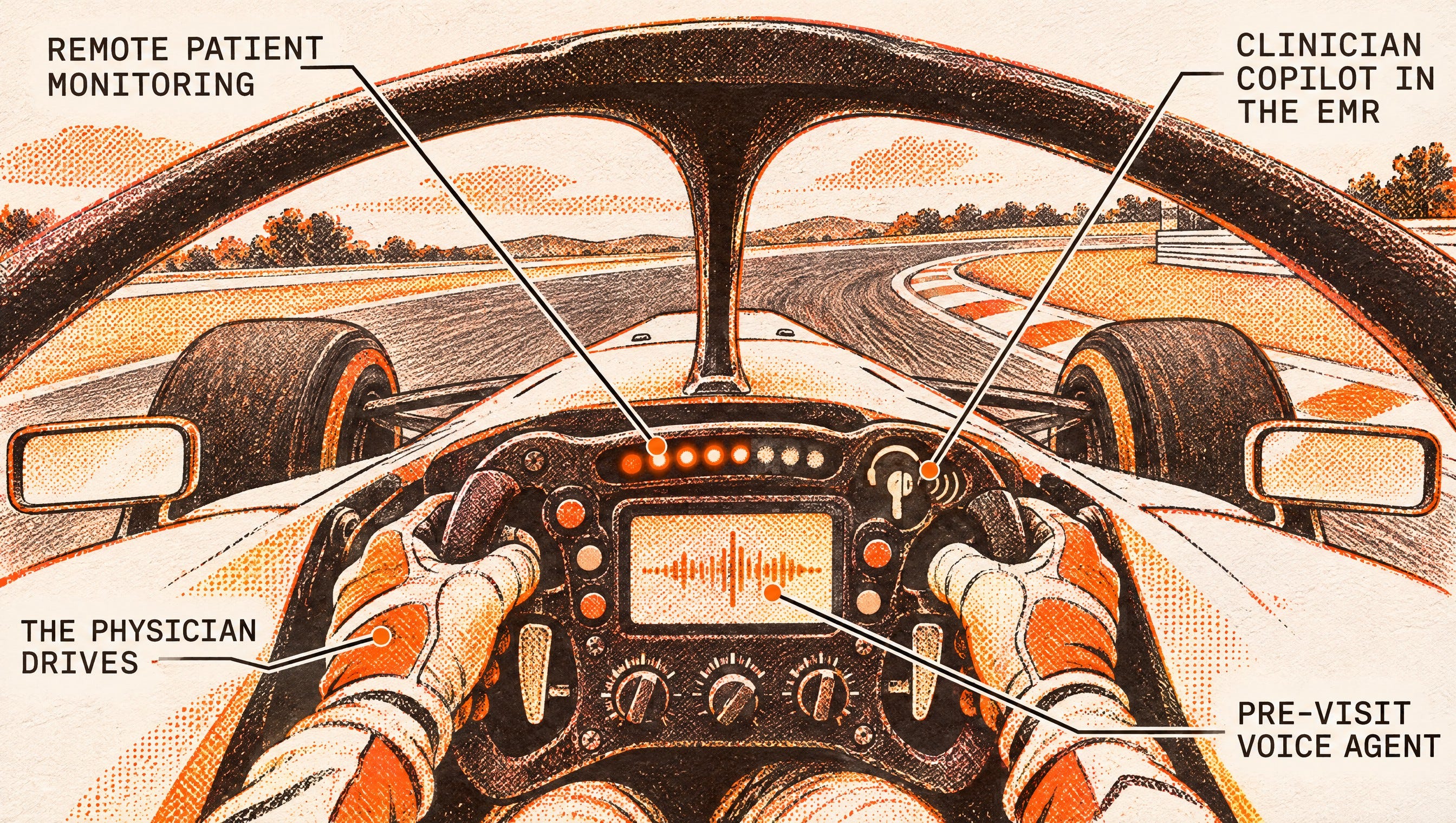
Think of an analogy to a Formula 1 driver. Speed is the number of patients seen. Crashes are safety incidents: the missed diagnosis, the lost referral, the abnormal result nobody followed up.
Telling a driver to just go faster gets you more crashes. That’s what “just see more patients” means in practice - shorter visits, thinner histories, more errors.
F1 teams don’t get faster that way. They engineer the system around the driver.
Pre-visit voice agents
The pit crew does work off the track. That’s the pre-visit voice agent: it calls the patient before the appointment, takes the history and hands over a structured note. Anyone who has done primary care will tell you history-taking eats a huge fraction of every visit.
Clinician copilots in the EMR
The race engineer talks in the driver’s ear. That’s the clinician copilot in the EMR: it summarizes the chart, triages the inbox, flags the overdue mammogram and surfaces the one result that matters, when it matters.
Remote patient monitoring between visits
Voice agents can call patients to check up on them in between visits, ensuring adherence to treatment plans and other lifestyle changes that are important for chronic disease management.
AI agents mean tradeoffs are no longer required
In this analogy, the driver still drives: the physician still examines, decides and owns the outcome. It’s not a human-in-the-loop, but a human at the center of the loop.
But around the human is a dashboard full of autonomous helpers that continuously boost efficiency and safety.
Here’s the interesting part: F1 cars got faster and safer at the same time. Speed and safety only trade off when you push the driver instead of improving the system.
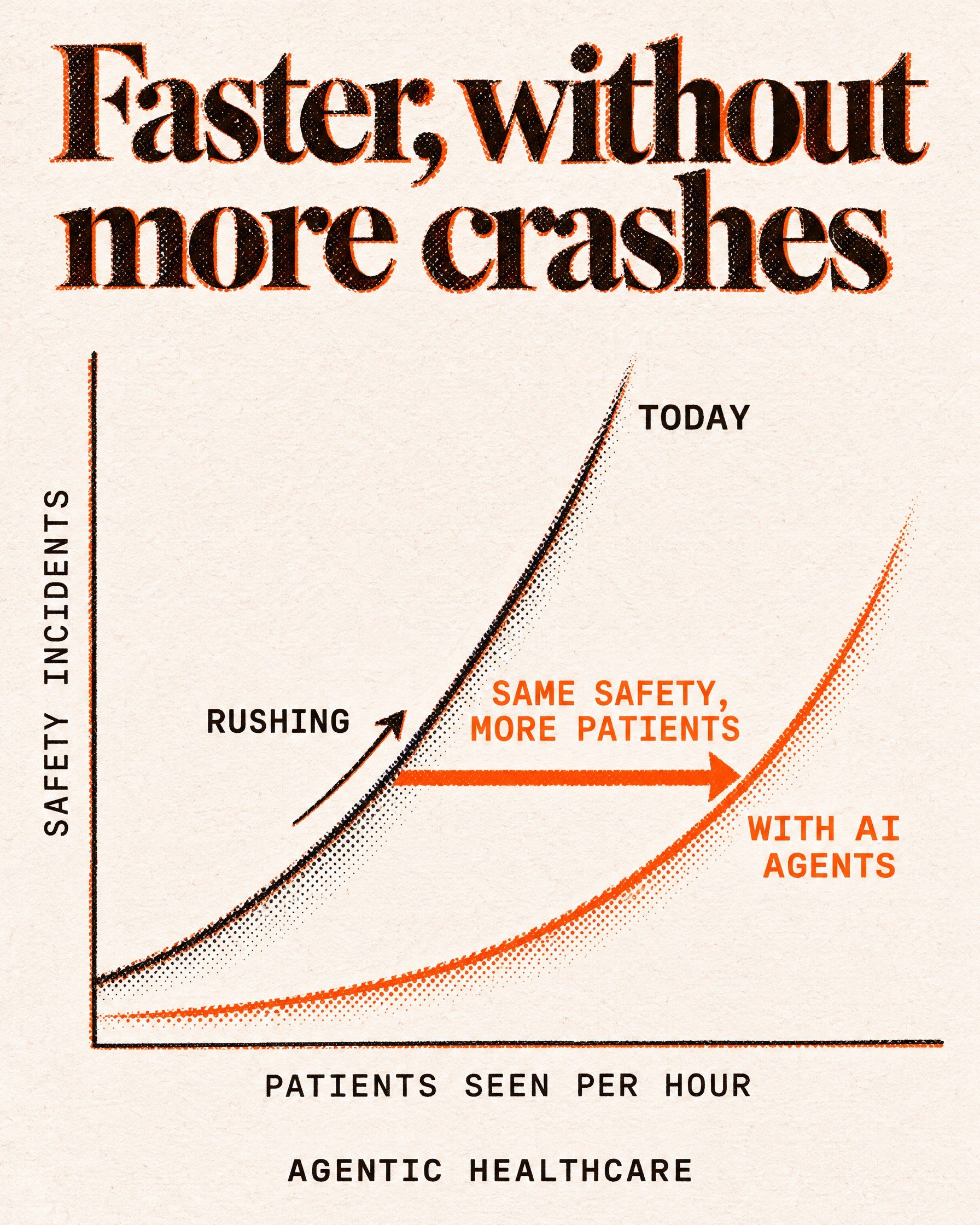
If agents make the same clinic 20% faster without adding crashes, a big chunk of Ontario’s family doctor shortage simply disappears.
Millions of people could get care that wasn’t previously available to them.
My view?
The province should treat these tools the way it treated scribes: fund them, set the safety bar, and let the best ones win.
Love it. In an AI first era I think traditional primary care panels can be re-thought. Management with agents, more specifically population health monitoring of complexity and comorbidity are all within a future
this also reminds me of the article written by @Peter Forte on primary care 🤔🤔🤔
I just attended a primary health care conference this past week that discussed several of these points!